Federal Government Case Study
Laptops

Enhancing Federal Operations with Mobile Computing Solutions for VR

Headwall empowers innovative command centers with virtual reality and extended reality capabilities. Headwall solutions combine proprietary video processing software with 3D and IoT sensor mapping and a hardware control API. Video processing allows federal customers, including government and military, to ingest and display large amounts of visual data. When enabled, the hardware control API allows for bidirectional control of the command center environment. This means video routes made in the virtual environment can be reflected in the physical command center; surveillance cameras can be panned, tilted, and zoomed; and KVM functionality is available.

Industry Trends
Cutting-edge virtual reality (VR) and mixed reality (MR) applications are known for being graphically demanding, requiring market-leading hardware to render realistic 3D environments. Enabling an accurate and consistent virtual experience is a GPU- and processor-intensive process that includes rendering high-resolution images at exceptionally high refresh rates. Many standalone headsets lack the compute power necessary to run rigorous applications. As a result, head-mounted displays (HMDs) are being connected to PCs to access the compute resources they need. Until recently, tower-style workstations and desktop PCs were required to deliver the right levels of compute performance and speed to support VR and MR.
Business Challenge
Headwall development efforts began in 2019 as a reaction to the disruption of the command center industry and its users caused by COVID-19. After working with the Department of Defense and large-scale enterprises, Headwall developed tailored solutions for mission-critical operations across the federal sector. Their technology serves as a visualization node for video, sensors, and 3D data within VR and extended reality (XR) headsets. These tools enable real-time decoding for high-resolution fidelity as well as rendering and manipulating 3D objects.
Headwall technology is designed for personnel to access command center resources from the field, where mobility and form factor are critical to work and communicate seamlessly. Some Headwall customers utilize standalone HMDs for base-level applications, while others require additional compute resources to run larger and more complex applications. Headwall needed the power of a desktop PC in a laptop form factor to extend visibility and control capabilities to remote operators. Traditional laptops and tower environments often lack the mobility and processing power to deliver realistic virtual experiences. To overcome this challenge, Headwall set out to develop a solution that can keep pace with the increasing compute and capacity requirements of VR and XR.
Headwall technology is designed for personnel to access command center resources from the field, where mobility and form factor are critical to work and communicate seamlessly. Some Headwall customers utilize standalone HMDs for base-level applications, while others require additional compute resources to run larger and more complex applications. Headwall needed the power of a desktop PC in a laptop form factor to extend visibility and control capabilities to remote operators. Traditional laptops and tower environments often lack the mobility and processing power to deliver realistic virtual experiences. To overcome this challenge, Headwall set out to develop a solution that can keep pace with the increasing compute and capacity requirements of VR and XR.
Approach
Developing a robust virtual solution offers significant advantages over physical command centers:
• Cost savings: Building and maintaining a physical command center can be expensive, whereas a VR command center can be set up and accessed remotely to reduce costs.
• Flexibility: VR allows users to easily switch between different virtual environments, such as simulations or mockups, while physical command centers may be limited to a single location and function.
• Immersion: VR can provide a more immersive experience for users, allowing them to interact with virtual environments in a more natural way than with traditional interfaces.
• Data visualization: Users can better understand and analyze large amounts of data by displaying it in a more intuitive and interactive way.
Headwall carefully evaluated the market for a reliable, mobile solution that could deliver desktop-level performance. Their goal was to identify a high-performance laptop that could power any HMD on the market and provide additional overhead to support even the most demanding virtual use cases. The company wanted to find a vetted solution they could confidently recommend to customers. After reviewing numerous commercial-off-the-shelf and custom solutions, Headwall selected the Raider and Titan series from MSI as the recommended laptops for their customer base.
• Flexibility: VR allows users to easily switch between different virtual environments, such as simulations or mockups, while physical command centers may be limited to a single location and function.
• Immersion: VR can provide a more immersive experience for users, allowing them to interact with virtual environments in a more natural way than with traditional interfaces.
• Data visualization: Users can better understand and analyze large amounts of data by displaying it in a more intuitive and interactive way.
Headwall carefully evaluated the market for a reliable, mobile solution that could deliver desktop-level performance. Their goal was to identify a high-performance laptop that could power any HMD on the market and provide additional overhead to support even the most demanding virtual use cases. The company wanted to find a vetted solution they could confidently recommend to customers. After reviewing numerous commercial-off-the-shelf and custom solutions, Headwall selected the Raider and Titan series from MSI as the recommended laptops for their customer base.
Result
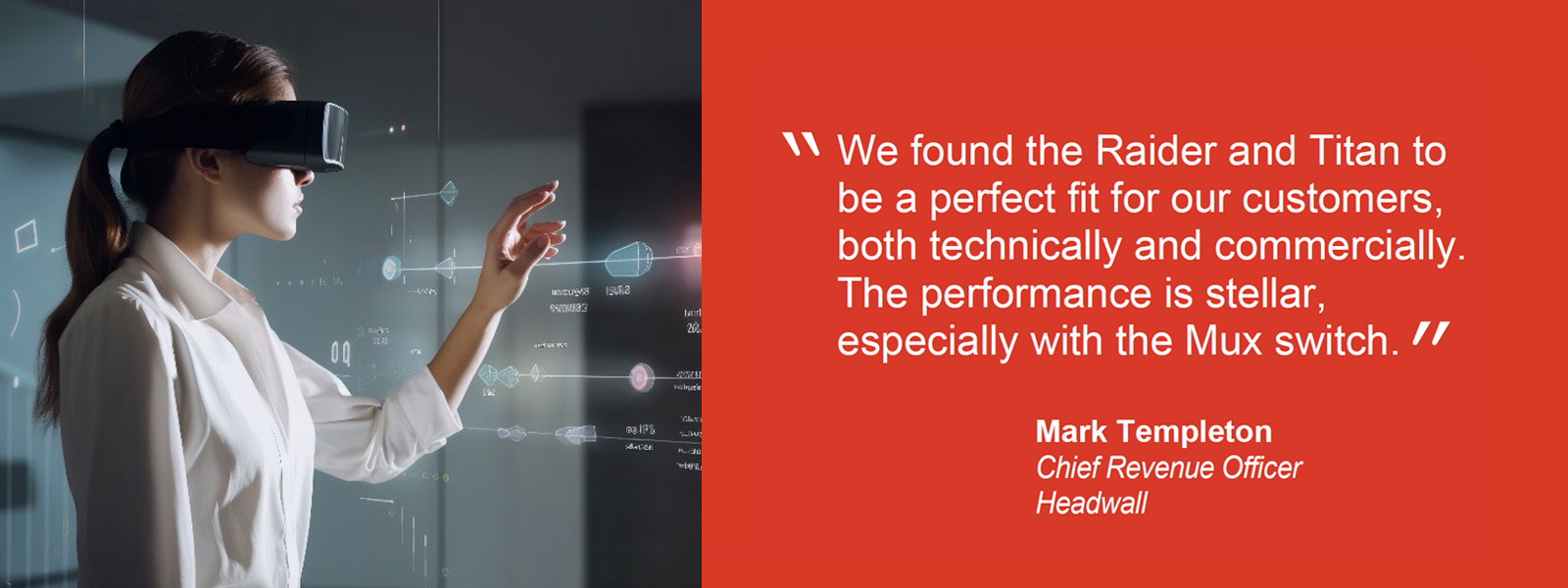
Headwall identified the Titan GT77 and Raider GE78 HX as being the best solutions to meet the needs of federal organizations and the diverse applications they use. The 13th Gen i9 processor and RTX4090 GPU provide desktop-level performance in a mobile form factor, while also offering a flexible array of I/O options to support any HMD. According to Mark Templeton, Chief Revenue Officer at Headwall, “We found the Raider and Titan to be a perfect fit for our customers, both technically and commercially. The performance is stellar, especially with the Mux switch enabled, which allows the GPU to run discreetly.”
As part of their evaluation, Headwall tested the Raider and Titan laptops using Headwall software and the most demanding HMD on the market. Both MSI laptops were able to achieve full performance from the software as well as the HMD, utilizing less than 70% of available GPU resources.
In addition to achieving exceptional compute performance, MSI solutions are durable and reliable to meet the challenges of federal operations, in office settings and beyond. “MSI products are capable of running in rugged environments, and they are widely available in most commercial markets,” added Templeton. “MSI also has options that are TAA-compliant, which is an essential feature for our federal government customers.”
Adopting MSI laptops has allowed numerous Headwall customers to upgrade their compute hardware and VR technologies for a variety of user types and use cases—such as VR visualization, modeling and simulation, and 3D modeling.
The realm of VR and XR is growing rapidly as applications continue to become more advanced and data-heavy. Headwall is preparing customers to succeed with the GPU-accelerated virtual environments that have the capabilities to meet the challenges of today and tomorrow.
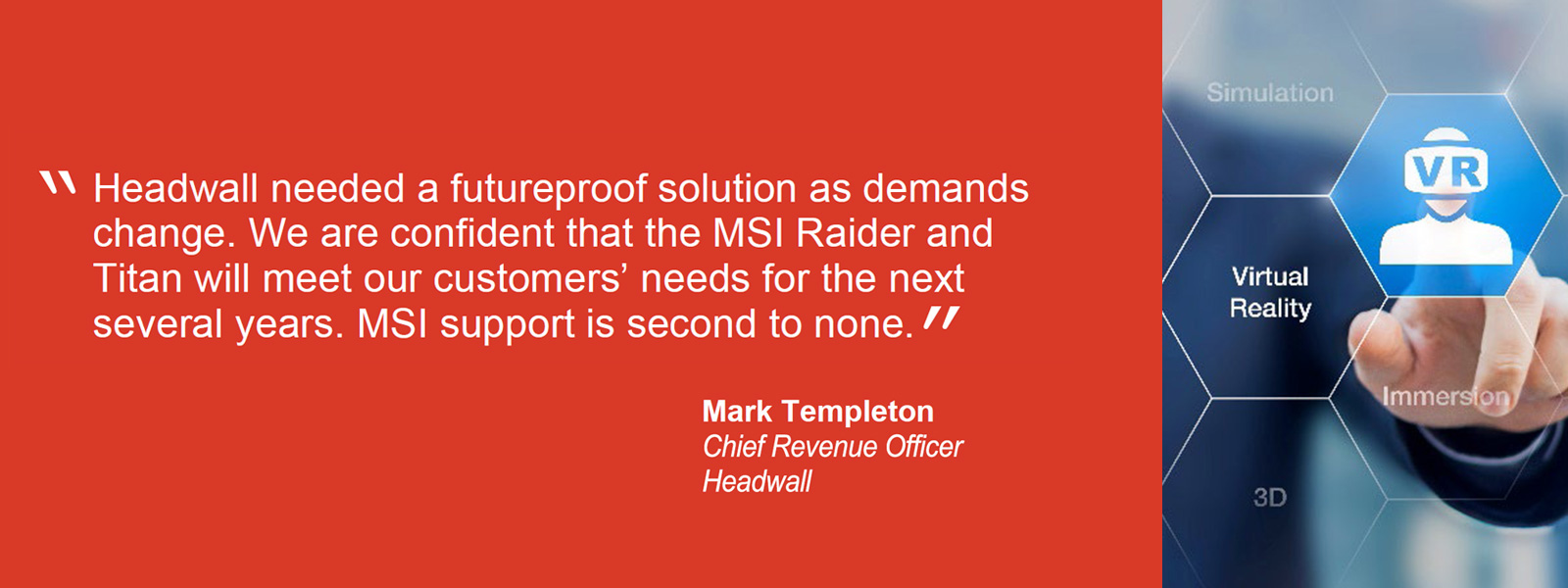
“Headwall needed a futureproof solution as demands change. We are confident that the MSI Raider and Titan will meet our customers’ needs for the next several years. MSI support is second to none.
As part of their evaluation, Headwall tested the Raider and Titan laptops using Headwall software and the most demanding HMD on the market. Both MSI laptops were able to achieve full performance from the software as well as the HMD, utilizing less than 70% of available GPU resources.
In addition to achieving exceptional compute performance, MSI solutions are durable and reliable to meet the challenges of federal operations, in office settings and beyond. “MSI products are capable of running in rugged environments, and they are widely available in most commercial markets,” added Templeton. “MSI also has options that are TAA-compliant, which is an essential feature for our federal government customers.”
Adopting MSI laptops has allowed numerous Headwall customers to upgrade their compute hardware and VR technologies for a variety of user types and use cases—such as VR visualization, modeling and simulation, and 3D modeling.
The realm of VR and XR is growing rapidly as applications continue to become more advanced and data-heavy. Headwall is preparing customers to succeed with the GPU-accelerated virtual environments that have the capabilities to meet the challenges of today and tomorrow.
“Headwall needed a futureproof solution as demands change. We are confident that the MSI Raider and Titan will meet our customers’ needs for the next several years. MSI support is second to none.
Adopting MSI laptops has allowed numerous Headwall customers to upgrade their compute hardware and VR technologies for a variety of user types and use cases—such as VR visualization, modeling and simulation, and 3D modeling.
The realm of VR and XR is growing rapidly as applications continue to become more advanced and data-heavy. Headwall is preparing customers to succeed with the GPU-accelerated virtual environments that have the capabilities to meet the challenges of today and tomorrow.
“Headwall needed a futureproof solution as demands change. We are confident that the MSI Raider and Titan will meet our customers’ needs for the next several years. MSI support is second to none.
The realm of VR and XR is growing rapidly as applications continue to become more advanced and data-heavy. Headwall is preparing customers to succeed with the GPU-accelerated virtual environments that have the capabilities to meet the challenges of today and tomorrow.
“Headwall needed a futureproof solution as demands change. We are confident that the MSI Raider and Titan will meet our customers’ needs for the next several years. MSI support is second to none.