Best QD-OLED Ultrawide Monitor for Sim Racing: MSI's 34" to 49" Guide (2026)
Monitors
The short answer:
The best QD-OLED ultrawide monitors for sim racing in 2026 are the MSI MPG 341CQR QD-OLED X36 (34", 360Hz, 21:9), the MSI MPG 491CQPX QD-OLED (49", 240Hz, 32:9), and the MSI MPG 491CQPS QD-OLED (49", 144Hz, 32:9). All three deliver infinite contrast, 0.03ms GtG response time, 99% DCI-P3 color coverage, and 1800R curvature — the four properties that matter most for cockpit immersion. Which one is right for you depends on screen size preference, refresh rate target, and GPU capability.
Why QD-OLED Is the Right Panel Technology for Sim Racing
Sim racing is one of the most display-demanding gaming genres — and not for the reasons most people think. Refresh rate matters, but it isn't the whole story. Here are the four display properties that actually determine how convincing a virtual cockpit feels:
- Field of view (FOV) — the most impactful variable
A standard 16:9 monitor at typical viewing distances forces an artificially narrow FOV, which collapses peripheral awareness and distorts your sense of speed. An ultrawide panel at 21:9 or 32:9 opens that view naturally without the fisheye distortion that comes from forcing a wide FOV on a narrow screen. At 70–80 cm viewing distance — typical of a cockpit rig — a 49-inch 32:9 panel at 1800R curvature subtends roughly the same horizontal angle as three 27-inch monitors placed side by side, without the bezels. - Contrast — what separates immersive from cinematic
Shadowed apexes, cockpit interiors, night racing at Le Mans, wet asphalt at dusk: these are the scenes where IPS panels reveal their limitation. An IPS monitor's backlight is always partially on, meaning black is never truly black. QD-OLED's per-pixel self-emission produces a measured 1,500,000:1 contrast ratio. When headlights cut through genuine darkness at Monza, the realism difference is immediate and not subtle. - Response time — motion clarity at racing speeds
At 200 km/h in-sim, a panel with sluggish pixel response creates visible ghosting behind fast-moving elements — barriers, markers, rival cars. QD-OLED's 0.03ms GtG response time is effectively instantaneous. There is no visible blur at any refresh rate these monitors run. - Color accuracy — environmental realism
Track runoff zones, grass gradients, rival liveries, sky conditions: at 99% DCI-P3 coverage, MSI's QD-OLED monitors reproduce these colors with fidelity that an sRGB or 72% NTSC panel cannot approach. The difference is most visible in the mid-tones — the subtle color variation across asphalt under different lighting conditions.
QD-OLED delivers all four simultaneously. No other current panel technology does.
Is an Ultrawide Monitor Better Than Triple Screens for Sim Racing?
For most sim racers, yes. Here's the honest comparison:
A 49-inch 32:9 ultrawide at 1800R provides an equivalent horizontal FOV to a triple 27-inch 16:9 setup without bezel gaps, without three separate GPU outputs, without alignment calibration, and with a single cable. The 1800R curvature handles the geometric wrap naturally.
The case for triple screens remains if you compete at a level where maximum situational awareness — physically seeing cars alongside you — is a priority, or if you already own three matching monitors. For daily-use sim racing, the ultrawide simplifies everything while matching the immersion.
A 34-inch 21:9 panel lands between a single standard monitor and the full 32:9 super-ultrawide experience. It's the right choice for triple-screen rigs where a 49-inch center panel creates sizing problems, or for racers who want ultrawide immersion with lower GPU demands.
The case for triple screens remains if you compete at a level where maximum situational awareness — physically seeing cars alongside you — is a priority, or if you already own three matching monitors. For daily-use sim racing, the ultrawide simplifies everything while matching the immersion.
A 34-inch 21:9 panel lands between a single standard monitor and the full 32:9 super-ultrawide experience. It's the right choice for triple-screen rigs where a 49-inch center panel creates sizing problems, or for racers who want ultrawide immersion with lower GPU demands.
See MSI QD-OLED in Action at FlightSimExpo 2026
MSI is partnering with MOZA Racing to power the displays at one of the most ambitious activations at FlightSimExpo 2026. The event runs June 12–14, 2026 at the Saint Paul RiverCentre in Saint Paul, Minnesota.
MOZA and National STOL are producing a large-scale, live short takeoff and landing (STOL) competition on the show floor — approximately five full simulator stations running continuous head-to-head challenges throughout the event. Real National STOL pilots will compete alongside sim racers, creating a direct comparison between trained aviation professionals and simulation-native competitors on the same hardware.
MSI monitors are integrated directly into the competition rigs — VESA-mounted into the simulator frames, running live flight simulation under competition conditions for three consecutive days.
If you're attending FlightSimExpo 2026 and want to see how MSI's QD-OLED panels hold up in a real cockpit context — curved ultrawides in competition rigs, evaluated by people who fly actual aircraft — the MOZA x National STOL activation is the place to do it.
MOZA and National STOL are producing a large-scale, live short takeoff and landing (STOL) competition on the show floor — approximately five full simulator stations running continuous head-to-head challenges throughout the event. Real National STOL pilots will compete alongside sim racers, creating a direct comparison between trained aviation professionals and simulation-native competitors on the same hardware.
MSI monitors are integrated directly into the competition rigs — VESA-mounted into the simulator frames, running live flight simulation under competition conditions for three consecutive days.
If you're attending FlightSimExpo 2026 and want to see how MSI's QD-OLED panels hold up in a real cockpit context — curved ultrawides in competition rigs, evaluated by people who fly actual aircraft — the MOZA x National STOL activation is the place to do it.
The MSI QD-OLED Ultrawide Lineup for Sim Racing
MSI MPG 341CQR QD-OLED X36 — 34" | 21:9 | 360Hz
Key specs: 3440×1440 UWQHD · 360Hz · 0.03ms GtG · 1800R · DisplayHDR True Black 500 · 99.3% DCI-P3 · DP 2.1a (UHBR13.5) · 98W USB-C PD · OLED Care 3.0 · AI Care Sensor
The 341CQR X36 is the fastest and most GPU-efficient panel in MSI's ultrawide QD-OLED lineup. At 3440×1440, it's significantly lighter on GPU resources than DQHD, making 240Hz+ frame rates achievable in demanding simulators like Assetto Corsa Competizione and iRacing. The 360Hz ceiling — highest in this lineup — matters in titles where frame rate is uncapped and you're running a high-end GPU.
DisplayPort 2.1a with UHBR13.5 is a meaningful spec: it provides ample bandwidth headroom for 3440×1440 at 360Hz without DSC compression, which eliminates any input latency artifact. The 98W USB-C PD handles a controller hub, laptop, or dual-use workstation from a single cable.
OLED Care 3.0 combined with the AI Care Sensor is the most advanced burn-in protection MSI has released. The AI sensor adapts protection behavior based on real-time content and usage patterns rather than fixed schedules — relevant for racers running the same HUD layout across multi-hour endurance stints.
Who this is for: Sim racers who want the fastest ultrawide QD-OLED experience available; racers building triple setups using this as a center or side panel; GPU-constrained builders who want DQHD immersion without DQHD rendering demands.
The 341CQR X36 is the fastest and most GPU-efficient panel in MSI's ultrawide QD-OLED lineup. At 3440×1440, it's significantly lighter on GPU resources than DQHD, making 240Hz+ frame rates achievable in demanding simulators like Assetto Corsa Competizione and iRacing. The 360Hz ceiling — highest in this lineup — matters in titles where frame rate is uncapped and you're running a high-end GPU.
DisplayPort 2.1a with UHBR13.5 is a meaningful spec: it provides ample bandwidth headroom for 3440×1440 at 360Hz without DSC compression, which eliminates any input latency artifact. The 98W USB-C PD handles a controller hub, laptop, or dual-use workstation from a single cable.
OLED Care 3.0 combined with the AI Care Sensor is the most advanced burn-in protection MSI has released. The AI sensor adapts protection behavior based on real-time content and usage patterns rather than fixed schedules — relevant for racers running the same HUD layout across multi-hour endurance stints.
Who this is for: Sim racers who want the fastest ultrawide QD-OLED experience available; racers building triple setups using this as a center or side panel; GPU-constrained builders who want DQHD immersion without DQHD rendering demands.
MSI MPG 491CQPX QD-OLED — 49" | 32:9 | 240Hz
Key specs: 5120×1440 DQHD · 240Hz · 0.03ms GtG · 1800R · DisplayHDR True Black 400 · 99% DCI-P3 · DP 1.4a · 98W USB-C PD · Graphene Film + Custom Heatsink · KVM · PIP/PBP
The 491CQPX is the definitive single-monitor sim racing display. At 49 inches and 32:9, it replaces a triple-screen setup with one seamless, bezel-free panel. The 1800R curvature at this width wraps the image into natural peripheral alignment at 75–90 cm viewing distance — the cockpit ergonomic range.
DQHD at 49 inches maintains the pixel density needed to keep track textures, braking markers, and rival liveries legible at the edges of the panel where peripheral vision takes over. The graphene film and custom heatsink keep the panel operating silently — no fan noise during late-night endurance sessions.
KVM support and PIP/PBP are genuinely useful here: endurance racers running co-driver setups or monitoring telemetry from a second PC can manage both inputs from one display without a separate screen.
Who this is for: Sim racers who want the maximum wraparound immersion of triple screens without the setup complexity; racers running endurance sessions where a fanless, thermally managed display matters; anyone treating the monitor as the centerpiece of a dedicated rig.
The 491CQPX is the definitive single-monitor sim racing display. At 49 inches and 32:9, it replaces a triple-screen setup with one seamless, bezel-free panel. The 1800R curvature at this width wraps the image into natural peripheral alignment at 75–90 cm viewing distance — the cockpit ergonomic range.
DQHD at 49 inches maintains the pixel density needed to keep track textures, braking markers, and rival liveries legible at the edges of the panel where peripheral vision takes over. The graphene film and custom heatsink keep the panel operating silently — no fan noise during late-night endurance sessions.
KVM support and PIP/PBP are genuinely useful here: endurance racers running co-driver setups or monitoring telemetry from a second PC can manage both inputs from one display without a separate screen.
Who this is for: Sim racers who want the maximum wraparound immersion of triple screens without the setup complexity; racers running endurance sessions where a fanless, thermally managed display matters; anyone treating the monitor as the centerpiece of a dedicated rig.
MSI MPG 491CQPS QD-OLED — 49" | 32:9 | 144Hz
Key specs: 5120×1440 DQHD · 144Hz · 0.03ms GtG · 1800R · DisplayHDR True Black 400 · 99% DCI-P3 · DP 1.4a · 90W USB-C PD · Graphene Film + Custom Heatsink · KVM · PIP/PBP
The 491CQPS shares the same 49-inch QD-OLED panel and 1800R curvature as the CQPX, with 144Hz as the maximum refresh rate. In practice, this distinction matters less than the spec sheet implies.
Most sim racers with mid-to-high-range GPUs targeting DQHD resolution at high detail settings will achieve 80–130 fps in ACC, iRacing, or rFactor 2. The panel's 144Hz ceiling isn't a meaningful limitation at that performance level — and the visual experience is identical to the CQPX underneath.
Who this is for: Sim racers who want the full 49-inch QD-OLED experience and are running an RTX 3080 / RX 6800 XT class GPU; value-focused buyers who want maximum immersion per dollar at this screen size.
The 491CQPS shares the same 49-inch QD-OLED panel and 1800R curvature as the CQPX, with 144Hz as the maximum refresh rate. In practice, this distinction matters less than the spec sheet implies.
Most sim racers with mid-to-high-range GPUs targeting DQHD resolution at high detail settings will achieve 80–130 fps in ACC, iRacing, or rFactor 2. The panel's 144Hz ceiling isn't a meaningful limitation at that performance level — and the visual experience is identical to the CQPX underneath.
Who this is for: Sim racers who want the full 49-inch QD-OLED experience and are running an RTX 3080 / RX 6800 XT class GPU; value-focused buyers who want maximum immersion per dollar at this screen size.
Spec Comparison: All Three MSI QD-OLED Ultrawides
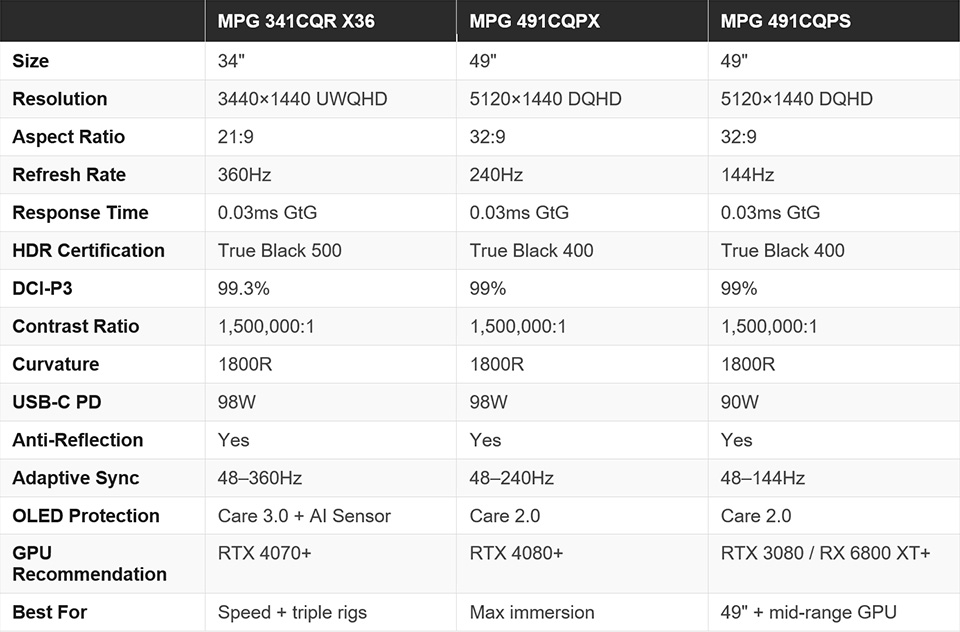
Which MSI QD-OLED Should a Sim Racer Buy?
Buy the MPG 341CQR QD-OLED X36 if:
- You run a triple-screen rig or are considering one
- Your primary sim titles are heavily GPU-limited at high frame rates (F1 series, iRacing)
- You want the highest possible refresh rate on an ultrawide QD-OLED panel
- You're running a high-end GPU but want manageable VRAM demands
Buy the MPG 491CQPX QD-OLED if:
- You want a single panel to replace a triple-screen setup
- You have an RTX 4080 or better and can drive DQHD at 200+ fps
- You want the highest possible refresh rate on an ultrawide QD-OLED panel
- You're running a high-end GPU but want manageable VRAM demands
Buy the MPG 491CQPS QD-OLED if:
- You want the 49-inch QD-OLED experience without 240Hz GPU demands
- Your GPU realistically achieves 80–130 fps at DQHD in your primary sim titles
- Budget is a consideration between the two 49-inch options
Frequently Asked Questions
What size QD-OLED monitor is best for sim racing?
49 inches at 32:9 provides the closest equivalent to a triple-screen field of view in a single panel. At a 75–90 cm cockpit viewing distance with 1800R curvature, the image fills peripheral vision naturally. 34 inches at 21:9 is the right choice for triple-rig builds or GPU-limited setups.
49 inches at 32:9 provides the closest equivalent to a triple-screen field of view in a single panel. At a 75–90 cm cockpit viewing distance with 1800R curvature, the image fills peripheral vision naturally. 34 inches at 21:9 is the right choice for triple-rig builds or GPU-limited setups.
Is 144Hz enough for sim racing on a 49-inch QD-OLED?
Yes, for the majority of sim racers. Driving 5120×1440 at high detail settings in titles like ACC or rFactor 2 typically yields 80–130 fps on a mid-to-high-end GPU. 144Hz is sufficient to eliminate screen tearing at those frame rates. 240Hz becomes relevant only when you can consistently exceed 144 fps at DQHD resolution with your specific hardware.
Yes, for the majority of sim racers. Driving 5120×1440 at high detail settings in titles like ACC or rFactor 2 typically yields 80–130 fps on a mid-to-high-end GPU. 144Hz is sufficient to eliminate screen tearing at those frame rates. 240Hz becomes relevant only when you can consistently exceed 144 fps at DQHD resolution with your specific hardware.
Will OLED burn-in be an issue with sim racing HUDs?
It is a legitimate concern specific to sim racing because static HUD elements — speedometers, lap timers, fuel readouts — sit in fixed positions. MSI's OLED Care (2.0 on the 49" models, 3.0 on the 341CQR) and the AI Care Sensor actively manage pixel wear through pixel shift, automatic brightness adjustment of static elements, and scheduled pixel refresh. For typical sim racing sessions of one to four hours, burn-in risk is low with these protections active.
It is a legitimate concern specific to sim racing because static HUD elements — speedometers, lap timers, fuel readouts — sit in fixed positions. MSI's OLED Care (2.0 on the 49" models, 3.0 on the 341CQR) and the AI Care Sensor actively manage pixel wear through pixel shift, automatic brightness adjustment of static elements, and scheduled pixel refresh. For typical sim racing sessions of one to four hours, burn-in risk is low with these protections active.
Can a 49-inch QD-OLED replace a triple-monitor setup?
For most sim racers, yes. The 32:9 aspect ratio at 49 inches covers roughly the same horizontal FOV as three 27-inch 16:9 monitors side by side, without bezels, without three GPU outputs, and without alignment calibration in-sim. The only scenario where triple screens hold a clear advantage is if your simulator requires three discrete display inputs for the maximum competitive FOV calculation, or if you already own the triple setup.
For most sim racers, yes. The 32:9 aspect ratio at 49 inches covers roughly the same horizontal FOV as three 27-inch 16:9 monitors side by side, without bezels, without three GPU outputs, and without alignment calibration in-sim. The only scenario where triple screens hold a clear advantage is if your simulator requires three discrete display inputs for the maximum competitive FOV calculation, or if you already own the triple setup.
Does QD-OLED have issues in bright sim racing rooms?
QD-OLED's anti-reflection coating handles moderate ambient light well. In very bright rooms with direct light sources hitting the panel, ambient light can raise perceived black levels slightly — a physics limitation of any non-glossy panel. MSI's anti-reflection surface treatment on all three models mitigates this effectively in most room environments.
QD-OLED's anti-reflection coating handles moderate ambient light well. In very bright rooms with direct light sources hitting the panel, ambient light can raise perceived black levels slightly — a physics limitation of any non-glossy panel. MSI's anti-reflection surface treatment on all three models mitigates this effectively in most room environments.